Slit Edge vs Mill Edge vs Trimmed Edge: A Guide for Tube Makers
Leave a message
The edge of the steel coil looks like a detail. On a hollow section production line it is not. The way the strip edge is finished changes how the weld seam behaves, how long the rolls last, and whether thin walls crack during forming. Most buyers never ask about it. They should, because the answer shows up in the finished tube.
We run all three edge types on our lines, so this is written from the shop floor rather than a textbook. Here is what each one is, where it wins, and where it costs you.
The three edge conditions, in plain terms
|
Edge type |
How it is made |
Typical burr |
Best use |
|
Mill edge |
As-rolled strip edge, never cut |
None from slitting, but carries scale |
ERW tube, general structural sections |
|
Slit edge |
Cut from wide coil by rotary knives |
0.05 to 0.15 mm |
Lower-cost runs, non-critical sections |
|
Trimmed edge |
Slit then side-trimmed to clean the edge |
Under 0.05 mm |
Tight-tolerance HSS, exposed surfaces |
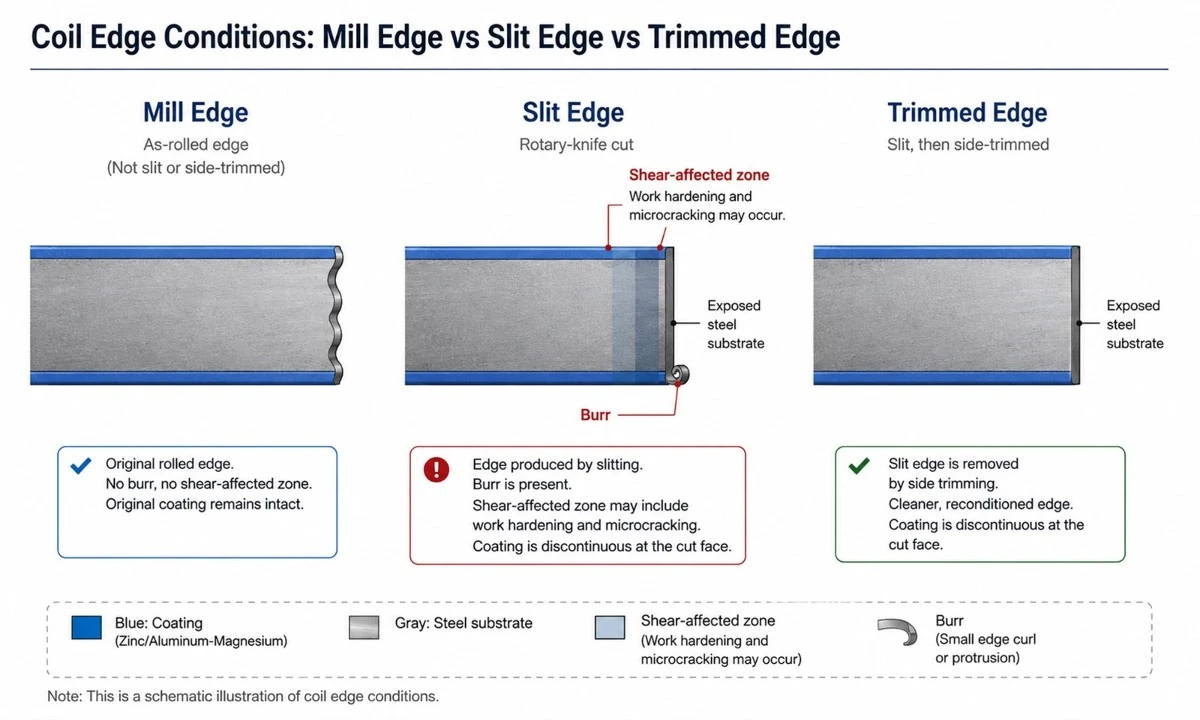
Figure 1: Coil edge conditions. The slit edge carries a burr and a work-hardened, micro-cracked zone at the cut; the trimmed edge is re-conditioned; the mill edge is as-rolled with no cut and continuous coating.
Burr height: the number that gets ignored
A standard slitting line leaves a burr of about 0.05 to 0.15 mm on the cut edge. On thin gauges below 2.0 mm that burr can reach 10 percent of the strip thickness, which is enough to matter. The burr points one way depending on knife setup, and if it points toward the roll it scratches the tool. A trimmed edge from a side-trimming unit normally stays under 0.05 mm, which is why plants that care about surface quality pay for the extra pass.
Crack risk in cold forming
This is where slit edge surprises people. The rotary knives do not just cut, they work-harden and micro-crack the edge zone. When that strip is cold roll formed into a thin SHS or RHS, the hardened layer can open into visible edge cracks, most often below 2.0 mm wall and on tight corner radii. Mill edge carries no slit burr but brings scale that must be cleaned before coating. Trimmed edge removes the work-hardened layer, so it is the safest choice for tight-tolerance sections and for any job where the edge will be visually exposed.
Impact on roll forming and tool life
Burr on a slit edge seeds two problems on the line. First, it scratches the roll surfaces and shortens tool intervals. Second, it can trigger edge wave and camber that show up later as out-of-square tubes. We have seen plants cut their surface reject rate by switching slit stock to trimmed edge on exposed architectural sections, even when the material cost rose by a small margin. The saving came back through fewer rejects and longer roll life.
Which edge should you specify?
For ERW tube where the edge becomes the weld seam, a clean mill edge or a trimmed edge gives the most consistent weld. Slit edge is workable and cheaper, but the burr direction has to be controlled and the edge conditioned before welding. If the section is painted, galvanized or used where the edge shows, trimmed edge pays for itself. For structural grades we discuss the choice alongside the steel grade in our Q235 vs Q195 guide, because thin-wall Q195 runs are exactly where slit-edge cracking shows up first.
Edge condition also ties into how the tube is later cut and welded on site. Our square tube 45 degree cutting guide covers layout and weld prep that assume a clean edge to start with.
FAQ
What is the typical burr height on a slit edge?
A standard slitting line leaves a burr of about 0.05 to 0.15 mm on the cut edge, sometimes up to 10 percent of the strip thickness on thin gauges. Trimmed edge from a side-trimming unit normally stays under 0.05 mm.
Does a slit edge crack more easily in roll forming?
Yes. The slitting knives work-harden and micro-crack the edge zone. In cold roll forming of thin SHS and RHS that hardened layer can open into edge cracks, especially below 2.0 mm wall. Mill edge carries no slit burr but has scale; trimmed edge removes the work-hardened layer and is the safest for tight-tolerance sections.
Which edge is best for welded hollow sections?
For ERW tube where the edge becomes the weld seam, a clean mill edge or a trimmed edge gives the most consistent weld. Slit edge is workable but needs burr direction control and edge conditioning before welding.
How does edge condition affect roll-form tool life?
Burr on a slit edge scratches the roll surfaces and accelerates wear, and it can seed edge wave and camber. Plants that switch from slit to trimmed edge often report longer tool intervals and fewer surface rejects on the finished section.
What is the difference between mill edge and slit edge?
Mill edge is the as-rolled strip edge that was never cut - no slit burr, but it carries mill scale. Slit edge is cut from wide coil by rotary knives, leaving a burr and a work-hardened, micro-cracked zone at the cut.
Is trimmed edge worth the extra cost?
For exposed, painted, galvanized, or thin-wall (<2.0 mm) HSS, yes - it removes the burr and work-hardened layer, reducing cracks, coating defects, and rejects. For non-critical, cost-driven runs, a conditioned slit edge is usually sufficient.
Which edge should I use for galvanized or painted HSS?
Trimmed edge. Its smooth, burr-free substrate gives the best coating continuity for hot-dip galvanizing and ZAM coatings, avoiding corrosion start points at the edge.
Further reading
Engineers trade notes on edge quality and forming defects in communities such as r/StructuralEngineering. For coating behaviour on different edge preparations, see our ZAM coating product page.
Written by the Yuantai Derun Technical Team. Specific figures are shop-floor ranges and should be confirmed against your mill certificate and the relevant product standard.