S235 Vs Q235 Steel: S235JR, Q235B & Differences
Leave a message
Quick Answer
S235 and Q235 are two widely used families of low-carbon structural steel specified by different standards. S235 is primarily associated with European standards such as EN 10025-2, while Q235 is specified in GB/T 700 in China. The names look similar because both are based around a 235 MPa minimum yield-strength level for thinner products - but that does not mean the grades are identical. For example, S235JR and Q235B are commonly compared grades, and both specify a 27 J Charpy impact requirement at 20°C; however, their chemical composition limits, product standards and certification requirements are not exactly the same. Whether Q235B can replace S235JR depends on the project specification and the acceptance of the designer, purchaser or inspection body. For steel pipes and hollow sections, the product standard matters: a structural hollow section supplied to EN 10219 cold-formed hollow sections or EN 10210 may use a designation such as S235JRH, rather than simply S235JR.

1. What Are S235 and Q235 Steel?
S235 is a European structural steel grade family. The designation is defined within the EN system, where "S" means structural steel and "235" refers to the nominal minimum yield-strength level of 235 MPa for products up to 16 mm in the relevant EN 10025-2 property table.
Q235 is a Chinese carbon structural steel grade specified by GB/T 700. The "Q" refers to the yield point, while "235" indicates the nominal yield-strength level for thinner products.
Neither number should be treated as a universal strength value for every thickness.
For example, under EN 10025-2:2019, S235JR has a minimum yield strength of:
|
Nominal thickness |
Minimum yield strength |
|
≤16 mm |
235 MPa |
|
>16–40 mm |
225 MPa |
|
>40–63 mm |
215 MPa |
|
>63–100 mm |
215 MPa |
|
>100–150 mm |
195 MPa |
|
>150–250 mm |
185 MPa |
Q235B under GB/T 700-2006 follows a similar thickness-dependent pattern:
|
Thickness |
Minimum yield strength |
|
≤16 mm |
235 MPa |
|
>16–40 mm |
225 MPa |
|
>40–60 mm |
215 MPa |
|
>60–100 mm |
215 MPa |
|
>100–150 mm |
195 MPa |
|
>150–200 mm |
185 MPa |
This is one reason a material comparison should always include grade, standard and thickness, rather than comparing the grade names alone.
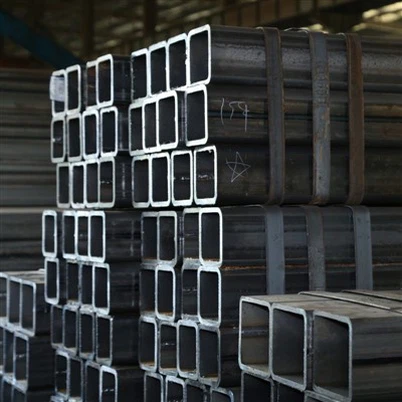
S235 and Q235 are used in many structural applications, including plates, sections and hollow structural sections. But the applicable product standard still needs to be identified.For example:
- EN 10025-2 - hot-rolled non-alloy structural steel
- EN 10219 - cold-formed welded structural hollow sections
- EN 10210 - hot-finished structural hollow sections
- GB/T 700 - carbon structural steel
- GB/T 6728-2025 - cold-formed structural sections in China (issued 2025-08-29, effective 2026-03-01, replacing GB/T 6728-2017 and GB/T 6723-2017)
For a square, rectangular or round structural tube, therefore, it is not enough to write only "S235" or "Q235" on an RFQ. The product standard should also be stated.
2. S235JR vs Q235B: Are They Equivalent?
This is the question buyers ask most often. The short answer is: they are comparable, but they should not be treated as automatically interchangeable.
S235JR and Q235B have several similarities. Both are widely used structural steels, both have a 235 MPa minimum yield-strength level for products up to 16 mm, and both specify Charpy impact requirements at 20°C.
The differences become clearer when you look at the standards side by side.
|
Property |
S235JR - EN 10025-2:2019 |
Q235B - GB/T 700-2006 |
|
Yield strength, ≤16 mm |
≥235 MPa |
≥235 MPa |
|
Yield strength, >16–40 mm |
≥225 MPa |
≥225 MPa |
|
Tensile strength |
360–510 MPa |
370–500 MPa |
|
Elongation, ≤40 mm* |
26% |
26% |
|
Charpy impact |
27 J at +20°C |
27 J at +20°C |
|
Carbon, max. |
0.17% |
0.20% |
|
Manganese, max. |
1.40% |
1.40% |
|
Phosphorus, max. |
0.035%(ladle) |
0.045% |
|
Sulfur, max. |
0.035%(ladle) |
0.045% |
* Elongation requirements depend on specimen type, thickness and test orientation. The table above is a simplified comparison for commonly referenced thickness ranges (longitudinal specimens, thickness ≤40 mm).
† S235JR phosphorus and sulfur limits per EN 10025-2: ≤0.035% (ladle analysis) and ≤0.045% (product analysis). Q235B lists 0.045% under GB/T 700-2006. Always compare against the actual mill test certificate (MTC).
The numbers show why the two grades are often compared in international steel procurement. At the same time, they are not identical specifications. S235JR has tighter limits for several chemical elements under the referenced EN 10025-2 requirements. Q235B has its own chemical and mechanical requirements under GB/T 700. So a certificate showing Q235B does not automatically demonstrate compliance with every requirement for S235JR. The safer approach is to compare the actual material certificate against the complete purchasing specification.
3. S235JR, S235J0 and S235J2 vs Q235B, Q235C and Q235D
The letters after the grade are important. They are not just different product names.
For S235 grades, JR, J0 and J2 identify different Charpy impact-test temperatures under EN 10025-2.
- S235JR: 27 J at +20°C
- S235J0: 27 J at 0°C
- S235J2: 27 J at −20°C
The Q235 quality grades follow a similar pattern in GB/T 700:
- Q235B: 27 J at +20°C
- Q235C: 27 J at 0°C
- Q235D: 27 J at −20°C
|
European grade |
Chinese grade |
Impact-test temperature |
Minimum impact energy |
How to view the comparison |
|
S235JR |
Q235B |
+20°C |
27 J |
Commonly compared |
|
S235J0 |
Q235C |
0°C |
27 J |
Commonly compared |
|
S235J2 |
Q235D |
−20°C |
27 J |
Commonly compared |
These are not "exact matches." Similar impact-test temperatures do not make the two grades identical. The same point applies to low-temperature applications. A grade being tested at +20°C does not mean the steel suddenly becomes unusable below +20°C. It means the standard's specified impact-toughness requirement is associated with that test temperature. If a project requires verified notch toughness at a lower service temperature, the material should be selected against that requirement rather than by the grade name alone. Also note that Q235E should not be included in a GB/T 700 comparison table. GB/T 700-2006 defines Q235 quality grades A, B, C and D.

4. Chemical Composition and Mechanical Properties
Chemical composition is where the idea of a simple "S235JR equivalent to Q235B" becomes less convincing. For a commonly referenced thickness range, the standard limits can be summarized as follows:
| lement | S235JR* | Q235B** |
|---|---|---|
| C, max. | 0.17% | 0.20% |
| Si, max. | ≤0.55% (residual) | ≤0.35% |
| Mn, max. | 1.40% | 1.40% |
| P, max. | 0.035% (ladle) | 0.045% |
| S, max. | 0.035% (ladle) | 0.045% |
| N, max. | 0.012% | not specified |
| Cu, max. | 0.55% | 0.30% (residual) |
| CEV, max. | ≤0.35 (t≤30 mm) | - |
* EN 10025-2:2019, ladle analysis, t≤40 mm. Si is a deoxidation element, typically ≤0.55% as residual. The N limit does not apply if total Al ≥0.015% (or acid-soluble Al ≥0.013%). Phosphorus and sulfur: ≤0.035% (ladle) / ≤0.045% (product analysis).
** GB/T 700-2006, heat analysis. Si, Mn, P, S are specified limits; Cu is a controlled residual element. Tighter Mn/Si values commonly appear on individual mill MTCs.
The mechanical properties also deserve attention. S235JR is specified with a tensile-strength range of 360–510 MPa for the common thinner product ranges, while Q235B is generally specified at 370–500 MPa under GB/T 700-2006. The yield-strength requirements are thickness dependent in both standards. That is why a proper steel grade comparison should look at more than yield strength. Check: chemical composition; yield strength; tensile strength; elongation; impact toughness; product thickness; manufacturing/product standard; inspection and certification requirements. This matters even more for structural hollow sections.
5. S235 Steel for Structural Tubes: EN 10219, EN 10210 and GB Standards
Buyers sometimes compare a plate grade directly with a finished hollow-section grade. For example, S235JR is a grade designation used under EN 10025-2. A structural hollow section manufactured to the EN 10219 cold-forming standard or EN 10210 may instead be designated S235JRH. The "H" is associated with the hollow-section product designation. S235JRH is the hollow-section designation that corresponds to the S235JR material grade, but must also satisfy the additional requirements of the hollow-section standard.
For structural tubes, the full specification should therefore look something like:
EN 10219-1 + S235JRH + specified dimensions and tolerances
rather than simply:
S235JR pipe
The same principle applies to Chinese products. GB/T 6728-2025 is now the current Chinese standard for cold-formed structural sections. It was issued on August 29, 2025 and took effect on March 1, 2026, replacing GB/T 6728-2017 and GB/T 6723-2017. The new standard covers cold-formed open sections as well as round, square and rectangular closed sections.
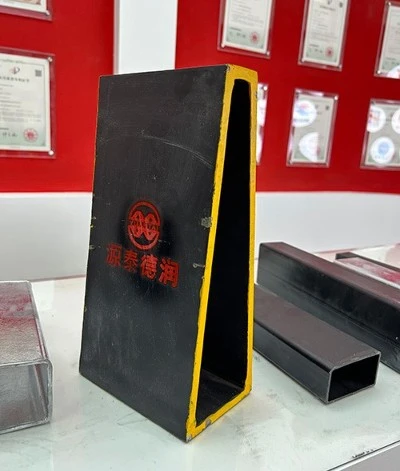
Note from our technical team: Yuantai Derun (Tianjin Yuantai Derun Steel Pipe Manufacturing Group) is listed among the drafting units of GB/T 6728-2025 (verifiable on the national standards portal, std.samr.gov.cn). Our production and inspection practices for cold-formed hollow sections are built directly on that standard, so the comparison below reflects first-hand involvement rather than second-hand translation.
This distinction is particularly important when comparing S235JR vs Q235B for square and rectangular tubes. Do not compare the material grade alone. Compare the complete product specification.
What about ASTM and JIS equivalents? ASTM A36 and JIS SS400 are often mentioned alongside S235/Q235 because they occupy a similar general structural-steel market segment. For hollow sections, ASTM A500 (cold-formed structural tubing) is the more relevant product specification in many U.S. projects. Still, "similar" is the better word than "identical." There is no formal cross-standard equivalence; any substitution should be based on a property-by-property comparison against the project specification. For example:
- S235 / Q235 - European and Chinese structural steel grades
- ASTM A36 - carbon structural steel for shapes, plates and bars
- ASTM A500 - cold-formed structural tubing
- JIS G3101 SS400 - Japanese rolled steel for general structure
- JIS G3466 STKR400 - Japanese carbon steel tubes for general structural purposes
For corrosion-protected tubes, note that ZAM (zinc-aluminum-magnesium) coatings are increasingly specified as an alternative to traditional hot-dip galvanizing for many structural environments. These standards have different chemical, mechanical, dimensional and testing requirements. A material should not be substituted solely because the nominal yield strength looks close.
6. Can Q235B Replace S235JR? Welding, Low Temperature and Material Selection
Can Q235B directly replace S235JR? Not automatically. Q235B and S235JR are frequently compared because their minimum yield-strength levels and room-temperature Charpy requirements are similar. But the two standards are not identical.
If a project specifies S235JR, the buyer should confirm whether Q235B is acceptable before production or delivery. Depending on the project, this may require review by the engineer, purchaser, consultant or third-party inspection agency.
A useful material-substitution review should include: applicable product standard; chemical composition; mechanical properties; impact requirements; thickness; manufacturing process; MTC requirements; welding requirements; project specifications; required certification.
A dual-grade certificate can be useful where the actual material satisfies both sets of specified requirements, but simply printing two grade names on an MTC should not be treated as proof of compliance.
Do S235JR and Q235B need preheating before welding? There is no universal "yes" or "no" based only on the steel grade. Both are generally considered weldable low-carbon structural steels. However, preheating and welding consumable selection depend on factors such as material thickness, carbon equivalent (CEV/Ceq), welding process, heat input, joint restraint, welding consumable, hydrogen control, ambient conditions, approved WPS and applicable welding code. For a production or site welding application, follow the qualified welding procedure rather than relying on a simple temperature rule.
Can S235JR or Q235B be used in cold climates? That depends on the design requirements. S235JR and Q235B specify Charpy impact testing at +20°C. If the project requires demonstrated impact toughness at 0°C or −20°C, the material specification needs to reflect that requirement. Depending on the applicable standard and project, grades such as S235J0, S235J2, Q235C or Q235D may be considered. The correct choice should come from the design temperature, required toughness and governing standard. In practice, impact-test temperature should not be confused with a fixed service-temperature limit.
When should you consider S355 or Q355? If a structure is heavily loaded or weight reduction is important, a higher-strength grade such as S355 or Q355 may be worth evaluating. S355 grades have a higher specified yield-strength level than S235 grades. That can provide more room for structural optimization, depending on the section, stability requirements and design code. For example:
| Lower-strength grade | Higher-strength grade | Typical reason for evaluation |
|---|---|---|
| S235JR / Q235B | S355JR / Q355B | Higher yield-strength level |
| S235J0 / Q235C | S355J0 / Q355C | Higher strength with comparable impact-test temperature |
| S235J2 / Q235D | S355J2 / Q355D | Higher strength for low-temperature toughness |
FAQ
q:Is S235 the same as Q235?
A:No. S235 and Q235 are comparable structural steel families from different standards. Their strength levels are similar in some thickness ranges, but the standards have different chemical, mechanical, testing and product requirements. For tubes, the applicable product standard - such as EN 10219 cold-formed hollow sections - should always be stated on the RFQ.
Q:Is S235JR equivalent to Q235B?
A:S235JR and Q235B are commonly compared grades with similar yield-strength levels and a 27 J Charpy requirement at +20°C. They should not, however, be treated as automatically interchangeable. Check the complete material and project requirements before substitution. For hollow sections, review our EN 10219 S235JRH square and rectangular tubes, built to the correct product standard.
Q:What is the ASTM equivalent of S235 or Q235?
A:There is no single one-to-one ASTM equivalent that applies to every S235 or Q235 product. ASTM A36 is commonly compared for structural plates, shapes and bars, while ASTM A500 is relevant to many structural tubing applications. The actual requirements should be compared before selecting a substitute. Our ASTM A500-grade ERW pipe covers many U.S. structural tubing specs.
Q:What is the difference between S235JR and S235J2?
A:The main distinction is the specified Charpy impact-test temperature. S235JR is tested at +20°C, while S235J2 is tested at −20°C. They are different grades within the S235 family and should be selected according to the project's toughness requirements.
Q:What is Q235B used for?
A:Q235B is widely used for general carbon structural-steel applications, including plates, sections and other structural products. For square, rectangular or round structural sections, the applicable product standard should be specified alongside the Q235B grade. For corrosion-protected tubes, see our ZAM-coated structural sections.
Q;What should I check before buying S235 or Q235 steel?
A:At minimum, confirm the standard, grade, product type, dimensions, thickness, mechanical properties, chemical composition, impact requirements, tolerances, inspection documents and delivery condition. For structural hollow sections, also confirm whether the project requires EN 10219, EN 10210, GB/T 6728-2025, ASTM A500 or another product standard. When a customer asks for an "equivalent" grade, the safest approach is to compare the full specification rather than relying on a grade-equivalence chart. Contact our technical team for a grade review against your project specification.