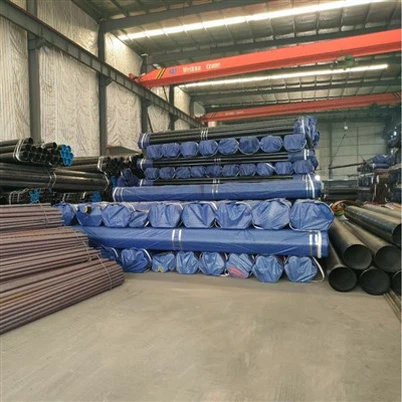
Detailed Pipe Pile Construction Process
Leave a message
I. Basic knowledge of pile foundation
1. Pile foundation
Pile foundation is the most commonly used foundation form for deep foundations. It consists of several piles sunk into the soil and a cap or cap beam connecting the top of the pile.
2. Function of piles
The function of piles is to transfer the load of the upper building to the deep soil layer with strong bearing capacity or to compact the soft soil layer to improve the bearing capacity and density of the foundation soil.

3. Classification of piles
(1) Classification by stress conditions
End-bearing piles: piles that penetrate soft soil layers and reach hard soil layers or rock layers. The resistance of the rock layer mainly bears the upper structure load. During construction, the penetration rate is mainly controlled. The depth of the pile tip entering the bearing layer or the pile tip elevation can be used as a reference.
Friction piles: completely set in the soft soil layer, the soft soil layer is squeezed and compacted to improve the soil density and bearing capacity. The load of the upper structure is jointly borne by the pile tip resistance and the friction resistance between the pile body side and the foundation soil. During construction, the main focus is on controlling the design elevation of the pile tip, and the penetration rate can be used as a reference.
(2) Classification by construction method
Precast piles: According to the method of sinking into the soil, they can be divided into driven piles, water-driven piles, vibration-driven piles, and static pressure piles.
Cast-in-place piles: piles are made by drilling holes at the pile position, then inserting steel skeletons, and then pouring concrete. Cast-in-place piles are divided into bored cast-in-place piles, excavated cast-in-place piles, punched cast-in-place piles, and pipe-sinking cast-in-place piles according to the different hole-forming methods.
Ⅱ. Prestressed pipe piles
1. Scope of application of pipe piles
(1) Prestressed high-strength concrete pipe piles (code PHC) and prestressed concrete pipe piles (code PC) are suitable for the foundations of industrial and civil buildings. It can also be used in the foundation design of railways, highways, bridges, ports, water conservancies, municipal engineering, structures, and other projects.
(2) Prestressed concrete thin-walled pipe piles (codenamed PTC) are suitable for the foundation of industrial and civil buildings.
(3) PHC piles and PC piles are suitable for areas with a seismic fortification intensity of no more than 7 degrees; if used in areas with a higher seismic fortification intensity, additional verification is required.
(4) PTC piles are suitable for areas with a seismic fortification intensity of less than 7 degrees, and areas with a seismic fortification intensity of 7 degrees require additional verification; PTC piles shall not be used in areas with a seismic fortification intensity greater than 7 degrees.
(5) When the environment and geological conditions of the foundation project are corrosive to the pipe piles, effective technical measures should be taken.
(6) Pipe piles are mainly considered to bear vertical loads.
2. Main construction methods of pipe pile foundation
(1) Hammering method: diesel hammer, hydraulic hammer;
(2) Static pressure method: hydraulic pile driver;
(3) Hole driving (pressing) method;
(4) Drilling and piling method;
(5) Middle excavation method (diameter ≥ 600).
3. Focus on the working principle of diesel pile driver
The diesel pile driver consists of a diesel pile hammer and pile frame. The pile frame can be special or modified by adding a gantry frame to the long arm boom on the excavator or crane. Diesel pile hammer is divided into guide rod type and cylinder type according to its action characteristics. The impact body of a guide rod pile hammer is a cylinder, which has a simple structure but small piling energy; the impact body of a cylinder pile hammer is the piston, which has large striking energy and high construction efficiency. It is a widely used piling equipment at present.
(1) Spraying diesel and compressed air
The upper piston falls and hits the fuel lever so that the fuel pump sprays a certain amount of diesel hammer to the impact surface of the lower piston through the fuel injection nozzle. When the upper piston continues to fall through the air intake and exhaust ports, it begins to compress the air in the cylinder. The gradually increasing air pressure presses the lower piston and the pile cap tightly against the pile head.
(2) The diesel pile hammer series uses the impact energy of the free fall of the impact part and the energy of the diesel combustion explosion to sink the pile. It is essentially a single-bar and stroke diesel engine. When the piston descends and touches the oil pump block, it begins to spray oil into the central ball groove of the hammer seat; when the piston continues to descend until the air intake and exhaust are closed, the air is compressed. This is the process of oil injection and compression. After that, the piston descends until it hits the hammer seat, generating a strong impact force to sink the pile. At the same time, the diesel injected into the ball groove is atomized and ignites and burns under the action of high-temperature and high-pressure air. The combustion and explosion force pushes the piston upward while exerting pressure on the hammer seat.
(3) When the piston ascends and passes the air intake and exhaust ports, the exhaust gas is discharged outside the cylinder. The exhaust gas in the cylinder is discharged, but the piston still has to inertia upward, so fresh air is sucked in again. When the piston descends again, part of the fresh air in the free cylinder is swept out of the cylinder. Until the piston moves downward to the position shown in the figure. This completes a working cycle.
(4) Scavenging, the upper piston continues to rise, causing negative pressure in the cylinder, fresh air is sucked in through the intake and exhaust ports, and the exhaust gas is completely swept out. The fuel pump's oil pressure lever is released and restored to its original position, and the fuel pump re-inhales diesel.
III. Pile driving equipment
1. The setting of the pile cap and cushion layer shall meet the following requirements:
(1) The pile cap shall have sufficient strength, rigidity, and resistance to impact.
(2) The pile cap should be made into a cylindrical shape, and the depth of the cylinder used to cover the pile head should be 350 to 400 mm, and the inner diameter should be 20 to 30 mm larger than the outer diameter of the pile.
(3) When piling, an elastic pad should be set between the pile cap and the pile head. The pad can be made of sacks, cardboard, cement paper bags, plywood, and other materials. The pad thickness should be uniform and the thickness after hammering and compaction should not be less than 120 mm; it should be checked frequently during piling and replaced or supplemented in time.
(4) Between the pile cap and the pile hammer, a "hammer pad" made of hardwood or coiled steel wire rope with a thickness of 150 to 200 mm should be used.
2. The pile driver and pad setting should comply with the following provisions:
(1) The pile driver should be made into a cylindrical shape and should have sufficient strength, rigidity, and impact resistance. The length of the pile driver should meet the requirements of pile driving concentration.
(2) The upper and lower-end surfaces of the pile driver should be flat and perpendicular to the central axis of the pile driver.
(3) The lower-end surface of the pile driver should have a hole to connect the inner cavity of the pile with the outside world.
(4) The pile driver should match the pile. The sleeve depth at the lower end of the sleeve pile driver should be 250 to 350 mm, and the inner diameter should be 20 to 30 mm larger than the outer diameter of the pile; the length of the pin at the lower end of the pin pile driver should be 200 to 300 mm, and the outer diameter should be 20 to 30 mm smaller than the inner diameter of the pile. For pipe piles with residual slurry in the inner hole, it is not advisable to use a pin-type pile driver.
(5) During the pile driving operation, 1 to 2 layers of sacks or cardboard should be placed between the pile driver and the pile head as a cushion.
IV. Pile Driving Construction Code
1. The pile hammer must not be started before the pile hammer is completely and securely placed on the pile head and all the required preparations and inspections have not been completed. The pile hammer must not be started when the lower piston is extended downward to prevent damage to the semicircular ring and the connecting flange or the lower cylinder.
2. The pile hammer must not be started when it is off the guide rail of the pile frame or parked on the pad to prevent accidents. To prevent eccentric pile driving, the axis line of the pile and the center line of the pile should be as close as possible to ensure uniform force on the pile head to avoid accidents. If the pile is driven eccentrically, the pile hammer will swing due to the eccentric impact, causing the lower cylinder to rupture or deform. In addition, if it is a concrete pile, it may break. To prevent this phenomenon, a pile cap with a guide can be used.
3. It is necessary to understand the soil quality of the construction site and avoid the phenomenon of chasing hammers. Strictly following the following operating specifications is an effective way to avoid chasing hammers: After the pile is self-sunk, do not rush to shift gears for construction. Use the landing gear to hook the upper piston up to a certain height, let it fall freely, and hit it in neutral gear with its weight, and repeat this operation. Then observe the penetration of the pile into the soil. Only when its penetration is less than 1.7m can it be operated in gear. However, the phenomenon of chasing hammers is caused by geological conditions. Therefore, the specific operation of the construction should be flexible according to the actual soil conditions to effectively avoid the phenomenon of chasing hammers.
4. If the upper piston of the pile hammer hits 10 times in a row and the pile sinks less than 2 cm, it must be stopped immediately.
5. If the pile penetration is found to be reduced during piling, you should always pay attention to whether the upper piston rebounds and jumps too high, and adjust the oil volume or stop the machine in time.
6. When the pile hammer is working, ensure that there is no foreign matter in the cylinder to avoid accidents.
7. The connecting bolts of the pile hammer guide plate and the landing gear guide block must be checked regularly to ensure that they are locked as required.
8. The fuel pump must be in neutral when parking. To prevent accidents, after changing piles or delivering piles, first use neutral gear to hit 1-2 times to ensure that the hammer does not explode and the piston does not move continuously (that is, the oil pump does not leak oil) before you can shift to a higher gear and work normally.
9. When dragging piles, use tires as pads.
V. Pipe pile injection
1. Pipe pile injection shall comply with the following regulations:
(1) The vertical deviation of the first section of the pipe pile when it is lifted and inserted into the ground shall not be greater than 0.5%, and it is advisable to use a long-level ruler or other measuring instruments for correction; if necessary, it is advisable to pull it out and reinsert it.
(2) During the injection of pipe piles, the center lines of the pile hammer, pile cap, and pile body should coincide. When the inclination rate of the pile body exceeds 0.8%, the cause should be found and corrected; when the pile tip enters the hard soil layer, it is strictly forbidden to use the method of forced pullback such as moving the pile frame to correct the deviation.
2. In case of any of the following situations, pile driving should be suspended and timely discussed and dealt with by the design, supervision, and other relevant personnel:
(1) Sudden change in penetration rate.
(2) Peeling and crushing of concrete at the pile head.
(3) Sudden tilt and displacement of the pile body.
(4) Obvious ground bulge, floating of adjacent piles, or excessive displacement.
(5) The total number of hammer blows exceeds the value specified in this regulation. (The total number of hammer blows for PHC piles should not exceed 2500, and the number of hammer blows for the last 1m of pile sinking should not exceed 300.)
(6) Irregular rebound curve of the pile body.
VI. Key points for quality control of prestressed pipe piles
1. Before construction
(1) The finished piles should be inspected for appearance quality according to the selected standard drawings or design drawings (whether there is leakage of grout at the joints of the pile body, exposed reinforcement, surface cracks, flatness, and groove height of the end plate, and voids at the pile end);
(2) The welding rods, pile sinking and other materials and equipment for butt-jointed piles should be inspected.
2. Construction process
(1) Check the driving (static pressure) depth, stop hammer (pile driving resistance) control standard, and pile body (frame) verticality;
(2) Pile connection quality, pile connection interval time, and pile top integrity;
(3) Number of hammer blows per meter (pile driving resistance), number of hammer blows in the last 1m (pile driving dynamic resistance), last three penetrations and pile tip elevation, etc.
3. After construction
(1) Visually check the pile body quality and welding quality after pile driving through pile hole lighting;
(2) Pile position deviation, pile top elevation, penetration, low strain dynamic measurement, static load test.