What Are Yield Strength And Tensile Strength?
Leave a message
Any material will eventually exceed a certain limit and be destroyed under the action of increasing or continuously constant or continuously alternating external force. There are many types of external forces that can cause damage to materials, such as tension, compression, shearing, and torsion. The two strengths of yield strength and tensile strength are only for tensile force. These two strengths are obtained through tensile tests, through a tensile testing machine (generally a universal testing machine, which can perform various tension, compression, and bending tests), with a specified constant loading rate (that is, the unit time The increase of internal tension), the material is continuously stretched until it breaks or reaches the specified degree of damage (for example, some butt weld strength tests can not be broken), the force that causes the final damage of the material is the tensile strength of the material ultimate load.
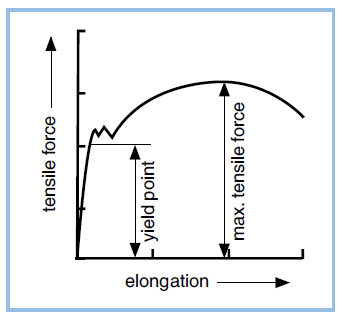
The ultimate tensile load is an expression of force, and the unit is Newton (N). Because Newton is a small unit, in most cases, kilonewton (KN) is used more often. Because various materials have different sizes, it isn't easy to judge the strength of materials by the tensile limit load. Therefore, the ultimate tensile load per unit area is obtained by dividing the top tensile load by the cross-sectional area of the experimental material.
The force per unit area is an expression of strength, and the unit is Pascal (Pa). Similarly, Pascal is a very small unit, which is generally expressed in megapascal (MPa). Therefore, the ratio of the ultimate tensile load to the cross-sectional area of the experimental material is the tensile strength. Tensile strength is the limit of the external force that a material can withstand per unit area. Beyond this limit, the material will be dissociatively destroyed.
So what is yield strength? Yield strength is only for elastic materials, inelastic materials have no yield strength. For example, various metal materials, plastics, rubber, etc., all have elasticity and yield strength. However, glass, ceramics, masonry, etc. are generally inelastic. Even if such materials are elastic, they are negligible, so there is no yield strength.
An elastic material is subjected to a constant and continuously increasing external force until it breaks. What has changed? First, the material undergoes elastic deformation under the action of external force, following Hooke's law. What is elastic deformation? When the external force is removed, the material will return to its original size and shape. When the external force continues to increase and reaches a certain value, the material will enter the plastic deformation period. Once the material enters plastic deformation, the original size and shape cannot be restored when an external force is applied. And the strength of the critical point that causes the two deformations is the yield strength of the material. Corresponding to the applied tension, the tension value at this critical point is called the yield point. From a crystal point of view, only when the tensile force exceeds the yield point does the crystal bond of the material begin to be broken. The damage of the material starts from the yield point, not from the fracture. Therefore, materials with high yield strength can withstand greater destructive power.