Two Metal Deformations in Square And Rectangular Tube Perforation
Leave a message
There are two kinds of metal deformation during the perforation process of metal square tubing, basic deformation and additional deformation.
(1)Basic deformation
It refers to the change in the shape of the appearance, which is a directly observable macroscopic deformation, and has nothing to do with the material properties. In the process of penetrating a solid round blank into a hollow metal square tubing blank, the macroscopic deformation includes extension deformation, circumferential deformation, and radial deformation. The deformation distribution in three directions of each section along the length of the deformation zone.
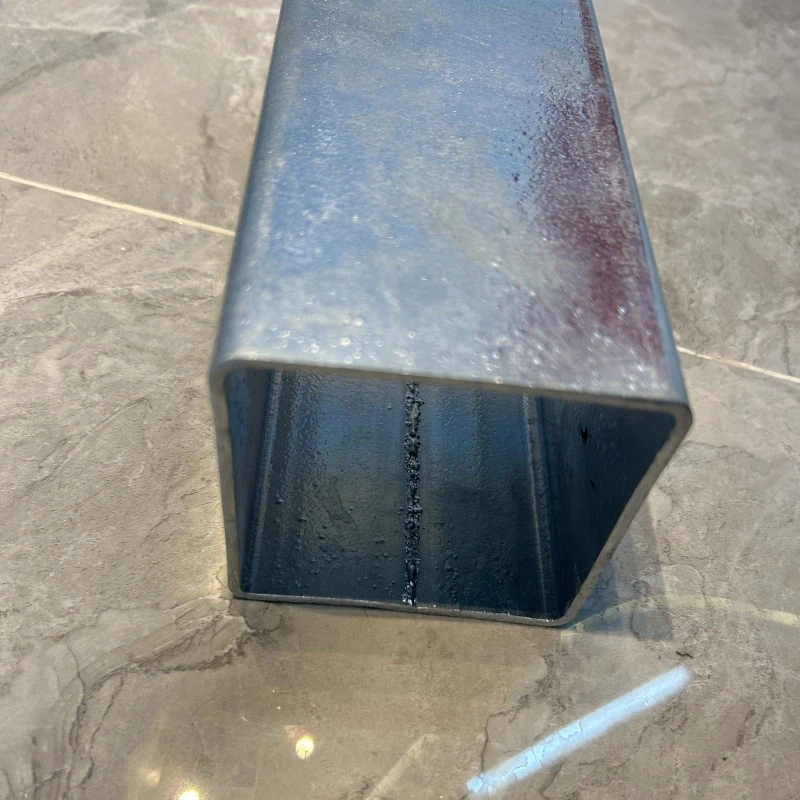
(2)Additional deformation
It refers to the directly invisible deformation inside the material, which is caused by the internal stress of the metal. Additional deformation will bring a series of consequences, such as increasing energy consumption during deformation and causing additional stress; it can easily lead to internal and external surface defects and internal defects of metal square tubing. Additional deformation is generally difficult to observe directly from the appearance of the tube blank, so special specimens must be used for research.
Additional deformations include the following three forms:
(1)Torsion deformation
When there is a straight line fold along the length direction of the square rectangular tube blank, the straight line fold turns into a large spiral fold after perforation. Another example is when heating the tube blank to produce two different surfaces. During the perforation process, the Yin and Yang surfaces on the tube blank are distributed in a large spiral shape on the capillary tube. These phenomena are all caused by torsional deformation. Torsional deformation is caused by the conflict between the movement and deformation of the tube blank and the roller. The torsional deformation is very small in the solid billet rolling stage and increases sharply in the head rolling stage.
(2)Tangential shear deformation
At the beginning of the perforation of the plug, since the peripheral speed of the plug surface is greater than the tangential flow velocity of the metal, the plug also drives the metal to flow in the tangential direction like a roller. In this way, the tangential flow velocity of the metal on the inner surface of the plug that is in direct contact with the plug is greater than the tangential flow velocity of the pipe. In the middle layer of the wall, the original linear stripes are deformed and distributed into a C-shaped curve; and as the deformation of the metal square tubing wall increases, the degree of curvature of the curve also increases. This will produce large tangential shear deformations between each layer of metal.
(3)Longitudinal shear deformation
The axial flow of the inner layer of metal is slower than that of the outer layer. During deformation, the inner layer of metal prevents the outer layer of metal from flowing axially to the inner surface for longitudinal shear deformation, resulting in longitudinal shear deformation between each layer of metal. Longitudinal shear deformation is caused by the axial resistance of the head. Because the roller drives the pipe to flow axially during piercing, the head prevents the axial flow of metal, which ultimately results in differences in the axial flow of each layer of metal. However, each layer of metal is an interconnected whole and cannot be separated. Therefore, additional deformation and additional stress will inevitably occur between each layer of metal, which often causes defects in the surface layer in direct contact with the roll and the head, or causes the original defects on the surface of the metal square tubing blanks to develop or expand.