Why Choose High-Strength Steel? The Real-World Benefits Explained
Leave a message
Let's be honest: material selection usually makes or breaks an infrastructure project. While standard carbon steel has been the go-to structural backbone for decades, high-strength steel (HSS) is rapidly taking over project spec sheets.
Why are so many procurement teams and structural engineers making the switch? It rarely comes down to just wanting a "better" material. It's about solving a very specific problem: balancing structural integrity with strict budget and weight constraints.
Here is a look at what actually happens when you upgrade your steel grade.
The Performance Gap: High Strength Steel vs Mild Steel
When you compare high strength steel vs mild steel on a project ledger, the difference becomes obvious fast. The yield strength of your standard mild steel (think S235 or standard A36) typically sits around 235 to 250 MPa. HSS grades, on the other hand, routinely push past 460 MPa and can easily exceed 700 MPa.
What does this actually mean on a job site? It means you can hit the same load-bearing targets using significantly thinner wall thicknesses. We regularly see typically achieve 10%–30% weight reduction depending on design optimization just by upgrading the material. Less weight means fewer trucks needed for shipping and lighter foundation requirements. This heavily drives down total project costs, when considering transportation, fabrication, and foundation costs per ton of the steel itself.
The Chemistry Behind the Muscle
You might wonder how the material achieves this without becoming too brittle to work with. It comes down to the high strength steel composition.
Steel mills use a highly controlled micro-alloying process. By adding trace amounts of elements like microalloying combined with TMCP-they change the internal grain structure of the metal. This specific chemical makeup ensures you get massive yield strength while keeping the steel tough and weldable.
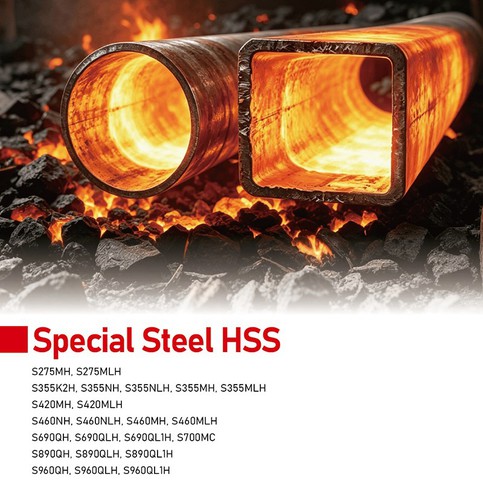
A prime high strength steel example would be the heavy-duty square and rectangular hollow sections used in modern crane manufacturing or long-span architectural frames, where structural failure simply isn't an option.

The Coating Synergy: ZMA
We also need to talk about longevity. A major trend right now is pairing high-strength structural tubes with Zinc-Aluminum-Magnesium (ZMA) coatings. It's a game-changer for harsh environments.
Unlike traditional hot-dip galvanizing, ZMA provides a "self-healing" effect on cut edges and scratches. If you're supplying materials for solar tracker torque tubes or heavy-duty livestock farming facilities, combining HSS with ZMA means you aren't just meeting the mechanical load requirements-you're guaranteeing the structure against chemical wear and tear for decades.
Beyond Basic ISO: The Need for Traceability
Of course, claiming high strength is one thing; proving it on site is another. Relying purely on a basic ISO 9001 certificate isn't enough anymore for high-stakes engineering projects.
The industry standard is shifting toward strict, factory-level traceability. Buyers increasingly want to see a "Digital Passport" for their steel-full transparency from the original heat number at the mill to the final ultrasonic (UT) or magnetic particle (MT) testing results on the weld seam. If the paperwork doesn't match the steel's performance, the grade doesn't matter.
High Strength Steel Grade Chart
|
Standard |
Grade |
Min Yield Strength (MPa) |
Typical Application |
|
EN 10219 |
S355J2H |
355 |
Standard structural framing |
|
ASTM A500 |
Grade C |
315 - 345 |
General construction, columns |
|
EN 10219 |
S460MH |
460 |
High-load infrastructure |
|
Specialty |
S700MC |
700 |
Heavy machinery, truck chassis |
FAQ
Q1: What are the exact high strength steel properties I should be checking?
A1:Beyond just looking at the yield strength, pay close attention to the Tensile Strength and Elongation (which tells you how ductile it is). If your project is in a freezing climate, you absolutely need to check the Impact Toughness (Charpy V-notch test) at sub-zero temperatures.
Q2: Does the altered composition make it harder to weld?
A2:Weldability is good, but requires stricter control of heat input, hydrogen levels, and preheating. Modern HSS is designed to be weldable. However, depending on the thickness and the specific grade, you may need to follow strict low-hydrogen welding procedures and pre-heating protocols to avoid cracking.
Q3: Is HSS more prone to rusting than regular steel?
A3:No. The base corrosion rate of standard high-strength steel is basically identical to mild steel. That's exactly why applying advanced surface treatments, like the ZMA coating mentioned earlier, is so critical for outdoor applications.