Seamless Pipe Production Process
Leave a message
1. Seamless pipe production process
According to different production methods, it can be divided into hot-rolled pipe, cold-rolled pipe, cold-drawn pipe, extruded pipe, etc.
Automatic rolling mills are commonly used to manufacture hot-rolled seamless pipes. After inspection and surface defect removal, the solid tube blank is cut into required lengths, centered on the end face of the perforated end of the tube blank, and then heated and perforated on a punching machine. During the continuous rotation and advancement of the perforation at the same time, under the action of the roll and the plug, a cavity called a capillary tube is gradually formed inside the tube blank. After that, it is sent to an automatic rolling mill to continue rolling. Finally, the average wall thickness of the entire machine is calculated, and the diameter is sized using a sizing machine to meet the specifications. Continuous pipe rolling mills are a relatively advanced method for producing hot-rolled seamless steel pipes.
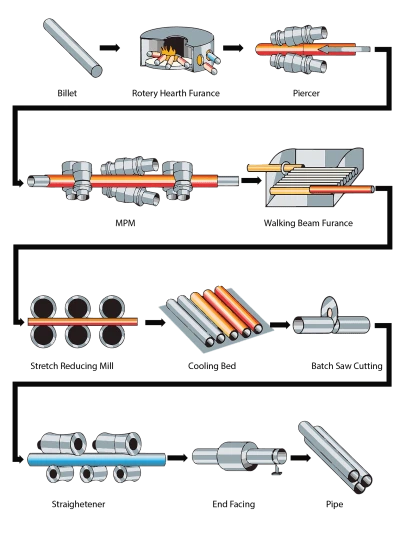
Cold rolling, cold drawing, or a combination of the two methods must be used to produce seamless pipes of smaller size and higher quality. Cold rolling is typically done on a two-roll mill, with the steel pipe rolled in an annular pass consisting of a variable-section circular hole groove and a stationary conical head. Cold drawing is typically done on a 0.5 to 100T single-chain or double-chain cold drawing machine.
The extrusion method is to place the heated tube blank in a closed extrusion cylinder, and the perforated rod and extrusion rod move together to extrude the extrusion part from the smaller die hole. This method can produce steel pipes with smaller diameters.
2. Purpose
It then moves on to the purpose after introducing the seamless pipe manufacturing process. Seamless pipes are very common. With the highest output, general-purpose seamless pipes are rolled from ordinary carbon structural steel, low-alloy structural steel, or alloy structural steel and are primarily used as pipelines or structural parts for conveying fluids.
It is classified into three types based on their various applications: a. chemical composition and mechanical properties; b. mechanical properties; and c. hydraulic test. Steel pipes supplied in categories a and b must also undergo a hydrostatic test if they are to withstand liquid pressure.
There are many kinds of seamless pipes for special purposes, such as seamless pipes for boilers, seamless pipes for geological use, and seamless pipes for petroleum.
Above all, these are seamless pipe production process and the use of seamless pipe.