Scaffolding Pipe Vs Ordinary Pipe: Key Differences
Leave a message
Global procurement managers know that sourcing scaffolding steel is rarely a 'plug-and-play' operation, as hidden variables in material tolerances and galvanization quality can make or break a project budget. Whether you are a purchasing manager or a project lead , the challenge is always the same: how to balance the immediate pressure of a project budget against the long-term necessity of site safety and regulatory compliance. True value in scaffolding isn't found in the initial price tag, but in the durability that survives multiple project cycles and the certification that passes every site inspection.
Understanding the market landscape requires more than just a passing knowledge of steel. It requires an appreciation for the nuances of international standards, the logistics of weight-to-strength ratios, and the chemical durability of surface treatments.
Navigating the Standards: BS 1139 vs. EN 39 vs. ASTM A500
The first thing any professional buyer searches for is compliance. In the global market, the debate often centers on BS 1139 and EN 39. While these standards are often used interchangeably in casual conversation, the precise mechanical tolerances they demand are what stand between a smooth customs clearance and a costly project delay.
BS 1139 is traditionally the gold standard for loose-tube and coupler scaffolding, particularly in Commonwealth markets. It specifies a rigid outer diameter of 48.3mm and demands high precision in wall thickness. On the other hand, the EN 39 standard is the go-to for European projects, focusing heavily on the chemical composition and the "flattening test" to ensure that the pipe will not crack under extreme pressure. For buyers targeting the North American or South American markets, ASTM A500 becomes the primary keyword. This standard covers cold-formed welded structural tubing and is essential for projects where scaffolding is integrated into more permanent structural frameworks. Failing to match the correct standard to your project's location can lead to costly delays at the port or, worse, a total shutdown by local safety auditors.

The Weight-to-Cost Logic: Choosing Between Q235 and Q355
From a buying habit perspective, cost is often calculated by the ton. However, the most experienced procurement officers look at the "cost per meter" and the "cost per shipment." This is where the choice between Q235 (S235JR) and Q355 (S355JR) steel grades becomes a strategic financial decision rather than just a technical one.

Q235 carbon steel is the industry baseline. It is affordable, widely available, and perfect for standard residential or low-rise commercial projects. However, it is heavy. In contrast, Q355 high-tensile steel offers a significantly higher yield strength. For a wholesale buyer, this means you can often specify a thinner wall-moving from a 4.0mm wall in Q235 to a 3.2mm wall in Q355-without sacrificing the load-bearing capacity. This shift reduces the "theoretical weight" of each pipe. When you are shipping thousands of tons across the ocean, a 15% to 20% reduction in weight translates directly into massive savings on ocean freight and inland transportation. Furthermore, lighter pipes allow for faster assembly on-site, reducing labor hours-a critical factor in high-wage markets.
Surface Protection: Why Hot-Dipped Galvanized is Non-Negotiable
The disparity in pricing between Pre-Galvanized and HDG tubes often dictates the procurement strategy. Understanding the operational durability of each coating is essential for buyers to determine whether a lower entry price aligns with the project's technical timeline.
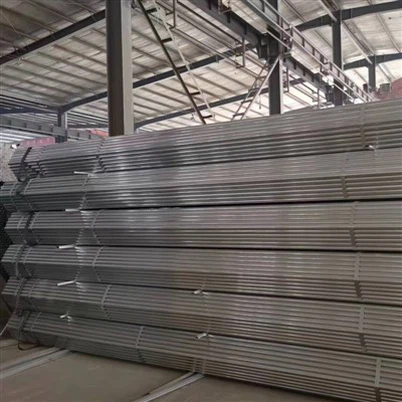
Pre-galvanized tubes are manufactured from pre-coated steel coils, offering a lower initial price. However, the forming and welding process destroys the zinc layer at the seam, exposing raw steel to the elements. Under harsh coastal conditions, this structural weak point can degrade within a single project cycle. To combat this, Hot-Dipped Galvanized pipes are dipped in liquid zinc only after all welding is complete, completely sealing the vulnerable seam.This ensures that the zinc coating covers every square millimeter, including the interior and the weld seams. For a rental company or a long-term infrastructure project, the "total cost of ownership" for HDG pipes is much lower because they can be reused for a decade or more, whereas cheaper pipes may be scrapped after just two projects.
The "Negative Tolerance" Risk in Wholesale Sourcing
A common habit among budget-focused buyers is to overlook the "Tolerance" section of a technical data sheet. In the steel industry, "negative tolerance" refers to the allowed deviation from the nominal wall thickness. If you order a 3.2mm pipe but the manufacturer operates at a -10% tolerance, you are receiving a 2.88mm pipe. While this saves the manufacturer money on raw materials, it compromises the "torque resistance" of your scaffolding couplers.
A professional procurement strategy involves demanding a MTC and, if possible, evidence of NDT. Reputable manufacturers use Ultrasonic testing or Eddy Current testing to ensure that the weld seam is continuous and free of defects. When a buyer asks for these documents upfront, it signals to the supplier that they are dealing with an expert who will not accept sub-standard materials. This "expert-to-expert" communication often results in better quality control and more transparent pricing.
Beyond the Pipe: Logistics and Factory Reliability
Finally, the buying habit of the 2026 market is no longer just about the product; it is about the supply chain. A buyer today isn't just looking for "scaffolding pipes"; they are looking for a partner who understands export tax refund documentation, European Carbon Border Adjustment Mechanism compliance, and just-in-time delivery.
When choosing a manufacturer, look for those who provide high-resolution industrial photography of their production lines and quality testing centers. The ability to see the "Ultrasonic Testing" or the "Zinc Layer Thickness Gauge" in action builds a level of trust that no low-price quote can match. In the industrial B2B sector, the most successful purchases are made when the buyer moves away from "spot-buying" and toward a partnership with a manufacturer who understands the technical parameters-such as the CEV for weldability or the R-angle precision for rectangular sections.
Strategic Procurement for Long-Term Success
Choosing the right scaffolding pipe is never a one-dimensional task. You're essentially managing a complex trade-off between rigid international codes like EN 10219 or ASTM A500, the logistical math of steel grades to curb rising freight costs, and the long-term chemical resilience of your coating. When procurement teams look past the initial 'price trap' and focus on these technical benchmarks, they aren't just buying steel-they are securing the project's bottom line and operational safety. YUANTAI DERUN always tell our clients: the cheapest quote quickly becomes the most expensive mistake once a pipe fails on-site. Real cost-efficiency is found in the pipe that remains compliant and structural, project after project.