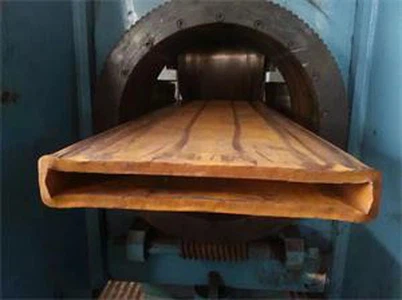
Five Points That Should Be Paid Attention To in Spray Rust Removal Of Square Rectangular Tube
Leave a message
When using spray de-rusting for square and rectangular pipes, the following five points should be paid attention to:
(1) Spray abrasive
In order to achieve the ideal rust removal effect, the abrasive should be selected according to the hardness of the square tube surface, the degree of original rust, the required surface roughness, and the type of coating. For single-layer epoxy, two-layer, or three-layer polyethylene coating, it is easier to achieve the ideal rust removal effect by using the mixed abrasive of steel grit and steel shot. Steel shot has the effect of strengthening the steel surface, while steel grit has the effect of etching the steel surface.

(2) Rust removal speed
The de-rusting speed of the square tube depends on the type of abrasive and the displacement of the abrasive, that is, the total kinetic energy applied to the steel pipe by the abrasive per unit time and the kinetic energy of a single abrasive. Generally, abrasives with a low loss rate should be selected, which is conducive to improving the cleaning speed and prolonging the life of the blade.
(3) Rust removal level
For the construction process of epoxy, vinyl, phenolic, and other anti-corrosion coatings commonly used for steel pipes, the surface is generally required to reach a near-white level. This level of de-rusting can remove almost all scale, rust, and other dirt, and fully meet the adhesion requirements between the anti-corrosion layer and the square tube, while the spray de-rusting process can be used with lower operating costs and stable and reliable quality Reach near-white technical conditions.
(4) Cleaning and preheating
Before spraying treatment, use a cleaning method to remove grease and scale on the surface of the square tube, and use a heating furnace to preheat the tube body to 40-60°C to keep the surface dry. During spraying treatment, since the surface of the pipe does not contain dirt such as grease, the effect of rust removal can be enhanced, and the dry surface is also conducive to the separation of steel shot, steel grit, rust, and scale, making the square rectangular pipe cleaner after rust removal.
(5) Abrasive ratio
If the roughness is too large, the anti-corrosion layer will become thinner at the peak of the anchor pattern; at the same time, because the anchor pattern is too deep, the square tube will easily form bubbles and seriously affect the performance. If the roughness is too small, the adhesion and impact strength will decrease. A reasonable ratio design can not only slow down the abrasion of abrasives on pipes and nozzles but also greatly improve the utilization rate of abrasives. During the operation, the mixed abrasives should be continuously sampled and tested. According to the particle size distribution, new abrasives should be added to the de-rusting machine, and the amount of steel grit should be the main one in the new abrasives added.